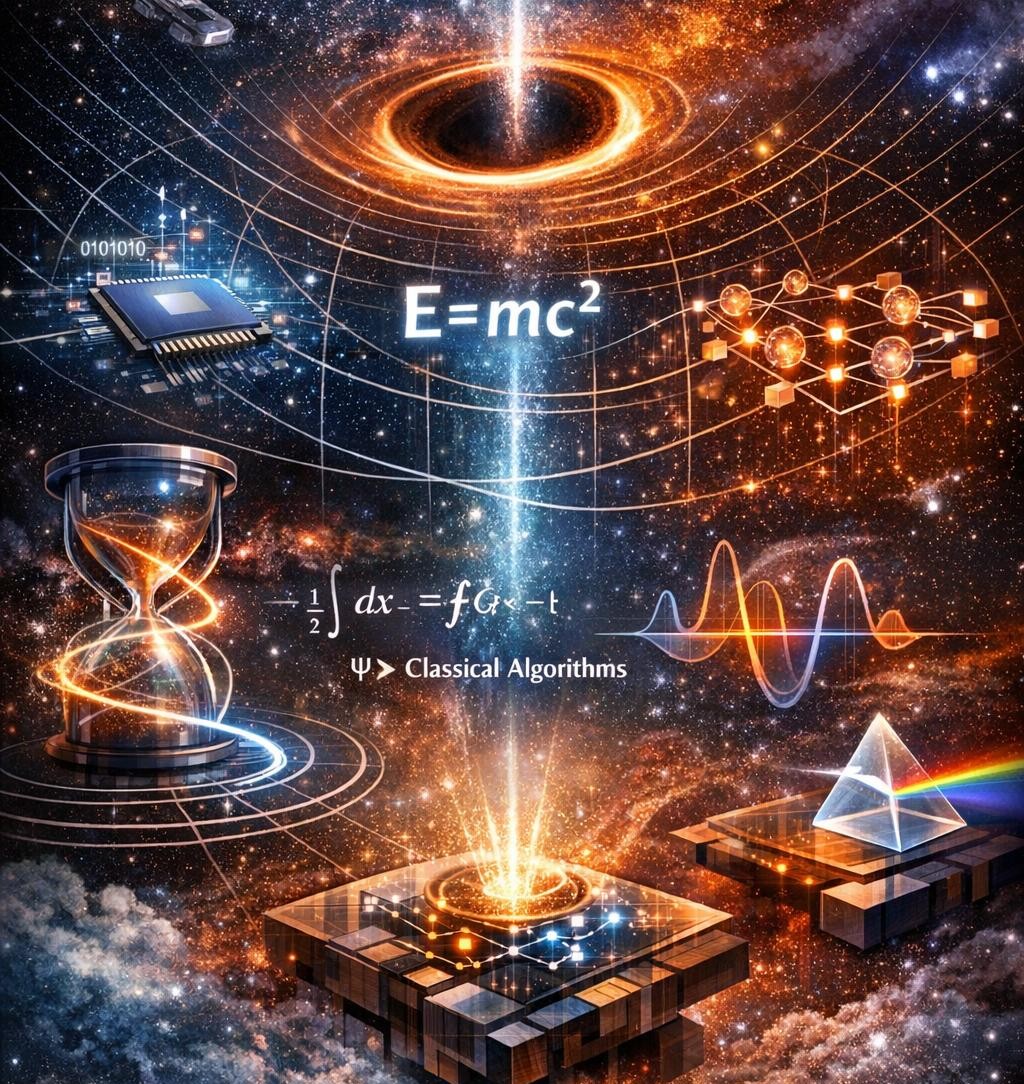
Classical algorithmic approaches have long struggled with some of the most challenging problems in computation — particularly those classified as NP and NP-hard. These problems grow exponentially in complexity, making efficient solutions impractical using conventional methods.
Qubitor was founded on a simple but powerful belief: computation does not have to be purely algorithmic — it can also be physical.
We explore how the laws of physics themselves can be harnessed as computational resources. Instead of forcing nature into digital abstractions, we let physical systems evolve naturally toward optimal solutions.
Our mission is to bridge computation and physical reality, enabling new ways to solve problems that were previously considered intractable.
Unlocking new computational paradigms by leveraging physics as a computational resource
To develop scalable, practical, and efficient systems that:
At Qubitor, we rethink computation from first principles. Rather than relying solely on classical algorithms, we design and utilize physics-based systems that inherently evolve toward optimal or near-optimal states. These systems can potentially solve complex optimization problems far more efficiently.
We investigate and build computational frameworks based on:
At the core of our methodology, real-world problems are transformed into the QUBO framework, where decisions are encoded as binary variables and solutions correspond to energy minimization. This enables encoding of complex and NP-hard problems, with constraints incorporated as penalty terms so infeasible solutions naturally carry higher energy. QUBO ultimately bridges computation and physics by mapping problems to physical systems that evolve toward optimal low-energy states.
We harness physical dynamics to naturally solve optimization problems by letting systems evolve toward minimum energy states, replacing traditional iterative computation with processes like thermal, mechanical, and magnetic behavior. QUBO problems are mapped onto physical Ising systems, where variables become spins, constraints become interactions, and optimal solutions emerge as low-energy configurations. Implementations span thermal, mechanical, and magnetic systems, along with emerging domains like optical, fluidic, photonic, and memristive networks.
We extend our method into quantum regimes using the Quantum Approximate Optimization Algorithm (QAOA). It explores solution spaces via quantum superposition, enabling simultaneous evaluation of many possibilities. This inherent parallelism can scale exponentially with system size. QAOA offers potential speedups for structured optimization problems using quantum interference and entanglement.
Combining classical computation with physical processes. Our hybrid architectures use classical systems to preprocess problems, manage constraints, and refine solutions, while physical or quantum layers perform the heavy lifting of energy minimization. This synergy delivers practical speedups for real-world industrial problems without requiring perfect hardware.
Research Publications
Industry Partners
Active Patents
Research Collaborators
Transforming Industries Through Physics-Based Computation

Qubitor enables industries to solve optimization and design problems that are beyond the practical reach of classical computation. By leveraging QUBO formulations, Ising systems, quantum optimization, and physics-based solvers, we unlock new efficiencies, better designs, and deeper insights. Our approach is especially powerful for:

Transforming Through Physics-Based Computation




We welcome collaborations, research partnerships, and industry discussions.
2026 © All Rights Reserved. Qubitor — Redefining Computation.